
The Principle
A brand is the expectation people carry into their next encounter with an organization. A name, color, photograph, phrase, email, welcome, correction, and ordinary act all contribute. None works alone. Repetition teaches people what to expect, and practice decides whether that expectation deserves trust.
For a church, this makes brand a question of public truthfulness before it becomes a question of styling. A church may explain a distinctive ministry practice, speak with a recognizable voice, and use consistent visual cues. It must also show what supports its promise, the limits of that promise, who remains accountable, and how a mismatch will be corrected. An attractive identity cannot repair an unreliable welcome, an inaccessible room, an unanswered concern, or a public value that leaders cannot evidence.
Positioning therefore means clarity, not superiority. It answers: What specific help or public activity is being described? For whom? What can a person reasonably expect? Which current practices make the description true? Distinctiveness makes the answer easier to recognize; consistency makes it easier to remember. Neither permits a church to attack neighboring congregations, disguise denominational or legal identity, invent a category, or turn one pastor into the product.
What the Evidence Shows
The commercial cases build recognition through contrast, human texture, repeated codes, narrow scope, category language, service details, and personal voice. Their visuals illustrate coherence by placing a repeated pattern beside its alternatives: identical figures face one vivid scene; yellow fields and literal labels recur on every surface; a familiar package loses its product cue; a human face outruns an institutional crest. The images do not test recognition speed. They show what the sources mean by a pattern that can be carried across encounters.
They do not establish that recognition produces trust, that follower growth reveals a cause, or that attention signals care. Several sources celebrate provocation, fandom, exclusivity, public vulnerability, or reputation recovery. Those incentives do not transfer to ministry. Church application begins only after verified practice, consent, access, safeguarding, and accountable human review.
Named Case Studies
A public promise has to be earned
"My guide to brand positioning" presents contrast, values, category creation, personality, and limitation as routes to a distinct place in the customer's mind.1 Its most useful idea for churches appears near the end: the one-line position rests on a story. The reviewed Drift diagram moves from a claimed problem through several assertions to "conversational marketing." The phrase works as a conclusion to that sequence, not as a substitute for it.
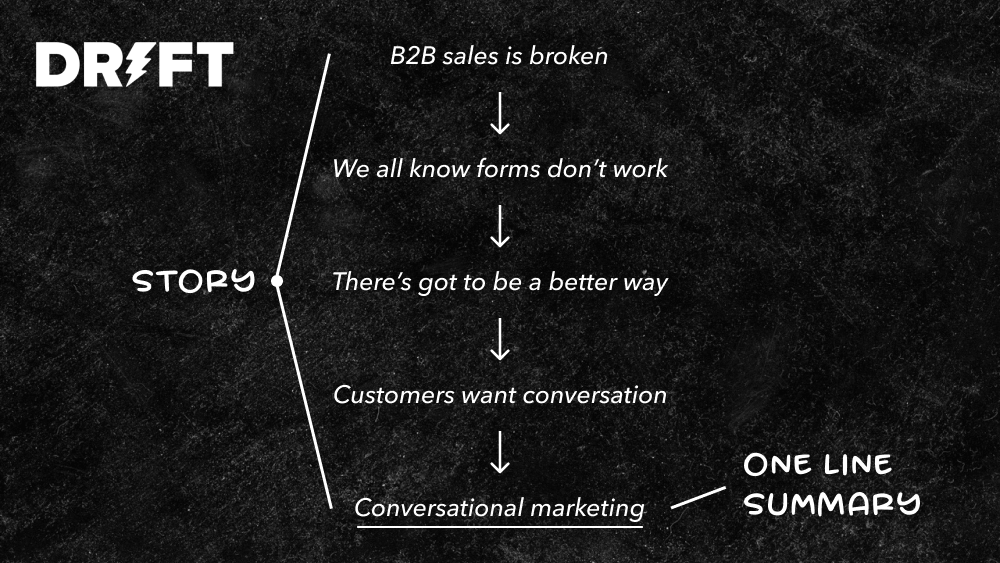
Marketing Examples' story-to-positioning diagram traces a problem through a sequence to a one-line category; it illustrates compression, not proof that the claims are true.
That sequence matters because a public story can make action legible or make people into props. "How LadBaby started a movement" links Mark and Rox Hoyle's story, sausage-roll parody songs, informal journey videos, a chart attempt, and food-bank support.2 The source's diagrams and posters keep the couple's journey in view. Its church boundary is equally visible: hardship and service recipients cannot become entertainment, and momentum cannot be manufactured as proof of faithfulness.
The deeper test is operational truth. "Real Marketing" compares institutional polish with reader language, customer photographs, informal copy, staff-shot video, children's drawings, and a named sender.3 A reviewed board contrasts a detached image of a painting with the maker holding the same work. The displayed vote counts belong to the archived example and do not explain why one post traveled further.
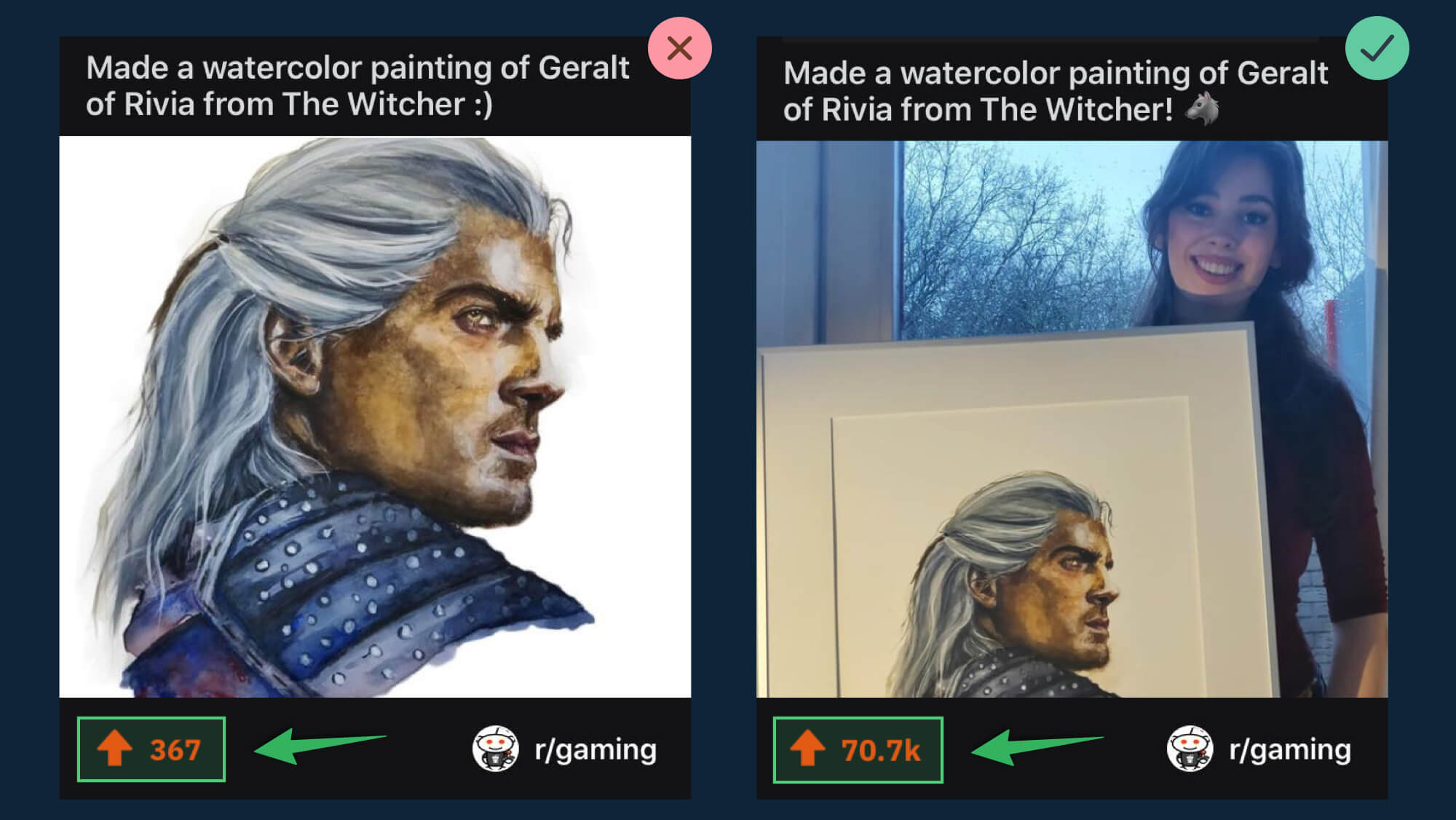
Marketing Examples' side-by-side post comparison makes the human maker visible; it does not establish a universal performance rule or permission to reuse the image.
The useful mechanism is provenance, but provenance is not a rough-looking filter. A phone camera can stage a scene, while a polished photograph can document real work accurately. Reasoned application: The church must first verify what happened, who took part, and what the material can honestly establish. Only then can personality enter the presentation. This returns the argument to positioning: the memorable line should compress a visible practice, and the image should reveal its source rather than impersonate authenticity.
Repeated conduct extends that logic. "How Jürgen Klopp makes fans smile" gathers a letter, supporter events, fan-channel interviews, calls, an open letter, and informal activities around Jürgen Klopp.4 The collage makes one leader the center of many encounters, including contact involving a minor. Reasoned application: It illustrates accumulated expectation, but also the danger of letting one visible personality stand for an entire institution. Anxiety, isolation, and private care cannot become evidence for a church brand.
"How Chewy delights customers" locates identity in service rather than a slogan: handwritten cards, commissioned pet portraits, flowers and condolence notes after a pet dies, and a wrong-food refund paired with a suggestion to donate the food to a shelter.5 The gestures are specific to the customer's situation. Reasoned application: For a church, bereavement and generosity must never become retention devices, publicity, or an implied exchange for gratitude.
Reasoned application: A church earns a narrow public promise through conduct that already recurs. Leaders should examine the ordinary experience before naming its character: what happens at the door, in the confirmation, during the activity, and when something goes wrong. Story and human texture may explain that practice, but neither can supply missing truth or prove care.
Distinctiveness works as a system, not a stunt
"The genius of no name's brand" describes a Canadian supermarket identity built from lowercase literal labels, a yellow field, narrow focus, and matter-of-fact humor across products, website, social media, advertising, and merchandise.6 The reviewed collage shows "website," "taxi," "stairs," a product label, and "twitter page" governed by the same rule.

Marketing Examples' cross-channel no name collage shows recognition accumulating through repeated verbal and visual codes; its distinctive yellow-and-black trade dress is not a church design kit.
The anchor is stronger than its yellow palette. One verbal and visual grammar survives changes of object and channel. That continuity turns many small encounters into one identity. Yet its success also makes imitation especially deceptive. Copying the colors, type treatment, literal joke, or packaging logic would borrow recognition rather than build it. Reasoned application: A church needs codes arising from its own name, setting, and practices, with accessible equivalents that preserve meaning rather than appearance alone.
The cases that follow test other kinds of distinctiveness. "The genius of Tesla's marketing strategy" credits founder behavior, spectacle, controversy, and customer-created videos in place of conventional advertising.7 The creator-thumbnail grid shows first-person product explanations, but its views and conversion arithmetic remain source claims. Reasoned application: Founder controversy, fan armies, and congregants treated as salespeople have no ministry equivalent.
By contrast, "CD Baby's confirmation email" finds personality inside a routine message.8 Derek Sivers replaced a standard dispatch line with a fanciful shipping story that readers copied into forums and blogs. The voice fits the company. Reasoned application: Church confirmations must keep operational facts ahead of creative flourish and must not pretend to intimacy.
"Becoming an antifragile brand" pairs Lewis Capaldi's playful response to insults with KFC's self-deprecating newspaper ad after a supply failure.9 The tipped bucket and altered mark compress ownership and apology into one image. Reasoned application: Humor may fit a low-risk operational mistake. It is forbidden where a person may have been harmed or where safeguarding, discrimination, abuse, or loss requires investigation and remedy.
Limitation supplies a quieter form of separation. "Serve a niche market. Get more attention" traces a Kanye West fan dating concept through a concentrated forum, specialist press, fan accounts, and direct outreach.10 Its specificity made the concept easy to describe, but contact harvesting, fandom, exclusion, and insider intensity do not transfer. Reasoned application: A church can narrow a resource by situation without narrowing human welcome by identity or status.
Reasoned application: Distinctiveness should come from a coherent scope and repeated choices, not from spectacle. A church can use a recognizable system and an appropriate voice when both serve the real task. The test is whether the identity still makes sense without controversy, borrowed trade dress, a viral moment, or pressure on other people to carry it.
Personal voice needs shared authority
"People Warm to People, Not Brands" compares Watford F.C.'s institutional YouTube account with goalkeeper Ben Foster's personal channel.11 The source reports different subscriber totals over different time spans. Its chart makes the human face visually outrun the club crest, but it cannot establish why growth differed.
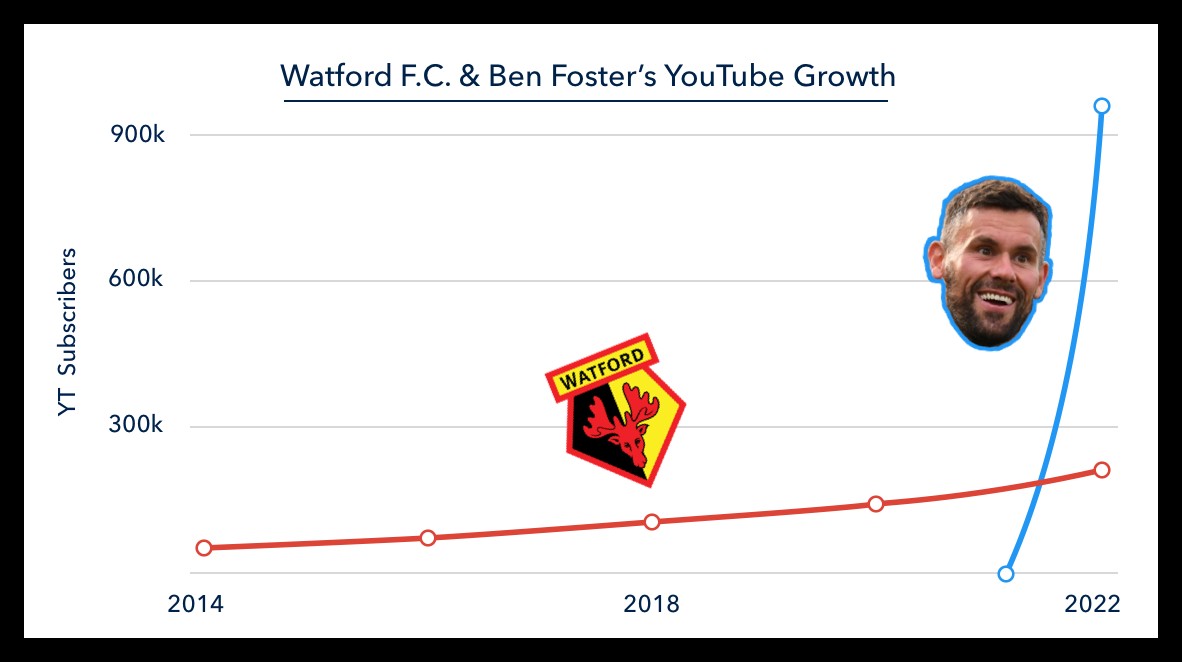
Marketing Examples' Watford F.C.–Ben Foster comparison makes personal presence concrete while leaving causation, content quality, and healthy accountability unresolved.
The source still reveals an important tension. A person has a voice, history, face, and point of view; an institution can sound abstract. Personal presence can therefore make responsibility legible. Reasoned application: In ministry, however, the same force can collapse the church into a founder or pastor. Familiarity can be mistaken for relationship, and audience loyalty can obscure who reviews claims or shares authority. The answer is not a faceless voice. It is personal communication bounded by review, distributed authority, and succession strong enough to outlast the speaker.
"One Tweet. Eighty media placements." shows the human boundary from another angle.12 ASOS featured a customer after she publicly shared insulting messages about its dress. The visual sequence depends on her post and photograph. Reasoned application: A church cannot appoint itself rescuer or turn abuse into a campaign; the targeted person controls whether any response becomes public.
Reasoned application: Let real people speak in their own approved capacity while keeping institutional claims subject to accountable review. A personal voice may illuminate responsibility; it must never absorb pastoral authority, imply private relationship, or make the speaker's visibility necessary for the organization to function.
Names and cues frame the category
Familiar cues help people locate what they already know. "This rebrand cost Tropicana $55M" visually contrasts an older orange-juice carton with a redesign that removes the orange-and-straw cue and rotates the name.13 The source offers a critique, not local user testing. Reasoned application: For a church, identity changes should preserve the verified relationship among old and new names, legal or denominational identity, place, and entrance. A redesign must not imply a new origin or history.
Names do more than identify; they tell people what standards and status to expect. "Reforge and the Strategic Use of Language" shows course language replaced by terms such as apply, selection, graduate, and alumni, then carried through professional-network notifications.14 Those words place the program inside an existing high-status educational category. Reasoned application: Ministry language must match actual governance, assessment, and recognition rather than borrow prestige or suggest mastery, endorsement, ordination, or spiritual rank.
If Reforge shows language placing an offer inside a familiar category, "How Loom Created a Category" shows language redrawing the category itself.15 OpenVid became "video messaging for work" by naming a remote-team problem and changing the comparison set from screen recorders to a use category. Its bucket diagram makes the reframing visible. Reasoned application: A church may name a real format descriptively, but cannot claim ownership of common practice, disparage others, or mimic a trusted category deceptively.
Naming meets action in "AG1's welcome offer is idiot-proof," which contrasts a crowded product panel with one complete welcome kit and one button.16 A clear default can lower decision effort. Reasoned application: In church communication, it cannot become a compulsory funnel, hidden registration, gift inducement, subscription, or promise of belonging; other access routes and the choice to take no action remain valid.
Reasoned application: Treat names, symbols, information order, and primary actions as promises about what a person will find. Keep category language descriptive, preserve the cues people use for orientation, and test changes with the people who must recognize and use them. Novelty is subordinate to truthful recognition.
Supporting Examples
The shorter cases keep the four anchors from becoming formulas. They show that accumulated expectation can form in service, a confirmation, a response to error, a narrow resource, an identity change, a program name, or a first action. The surface varies; the test remains whether the cue corresponds to something people can actually encounter.
They also show why memorable is not the same as faithful. Attention may come from spectacle, grief, insider identity, prestige, or public conflict. A church's brand discipline includes refusing those sources of recognition when they distort practice or use people as material.
The Church-Marketing Lesson
A church builds its public identity through accumulated expectations. People notice whether the same name appears on the sign and map, whether the advertised access route exists, whether a speaker explains their responsibility, whether a correction is acknowledged, and whether visual and verbal cues remain recognizable across print, web, email, and the building. Consistency is coordinated truth, not identical decoration.
This work needs human accountability. Communications teams can maintain the system; ministry leaders must verify the practice; accessibility, safeguarding, privacy, and other competent reviewers must govern their areas. Consent and image rights must cover the real use, and correction or withdrawal routes must work after publication. A pastor's or founder's voice may make a message concrete, but responsibility remains distributed. No personality should absorb the church's identity or pastoral authority.
AI may help organize approved brand material, find inconsistent labels, or format variants. It must not fabricate voice, testimony, history, values, pastoral authority, spiritual substance, origin, impact, or a claim that a practice exists. Humans must approve the exact promise, evidence, limits, likeness use, corrections, and publication context.
What Churches Should Not Copy
Do not copy superiority claims, adversarial positioning, personality cults, provocation, fan armies, manipulative belonging, fabricated authenticity, or virtue language without evidence. Do not exploit tragedy, disaster, grief, abuse, poverty, illness, anxiety, isolation, service recipients, or complaints to make the church look caring or resilient. Serious harm belongs to safeguarding, pastoral, legal, and accountable repair processes, never a reputation-recovery campaign.
Do not copy trade dress, marks, packaging logic, songs, photographs, likenesses, testimonials, or personal stories without rights and specific permission. Do not mimic academic, medical, governmental, charitable, or other trusted categories deceptively. Never invent origin, history, sustainability, impact, accreditation, endorsement, results, theology, or spiritual outcomes. A clever name, casual photograph, humorous apology, or leader's face cannot make an unsupported claim true.
Leadership Takeaways
Leaders should ask what expectation each public choice creates and which current practice supports it. Can a newcomer recognize the church and understand the offer without insider knowledge? Do the name and category cues describe the real work? Can the promise survive a change of pastor, designer, or platform? Are access, correction, consent, rights, and accountability as consistent as the colors and tone?
The strongest brand decision may be to narrow a claim, retire a familiar phrase, correct a mismatch, or leave a sensitive story unpublished. When public promise and practice align, people may choose to share what they experienced. The next chapter turns to Referral, where advocacy remains voluntary and no relationship becomes a distribution channel by obligation.
Sources
Footnotes
-
My guide to brand positioning; public source. ↩
-
How LadBaby started a movement; public source. ↩
-
Real Marketing; public source. ↩
-
How Jürgen Klopp makes fans smile; public source. ↩
-
How Chewy delights customers; public source. ↩
-
The genius of no name's brand; public source. ↩
-
The genius of Tesla's marketing strategy; public source. ↩
-
CD Baby's confirmation email; public source. ↩
-
Becoming an antifragile brand; public source. ↩
-
Serve a niche market. Get more attention; public source. ↩
-
People Warm to People, Not Brands; public source. ↩
-
One Tweet. Eighty media placements.; public source. ↩
-
This rebrand cost Tropicana $55M; public source. ↩
-
Reforge and the Strategic Use of Language; public source. ↩
-
How Loom Created a Category; public source. ↩
-
AG1's welcome offer is idiot-proof; public source. ↩
